Blog
Boiler Leaking Water? What to Check and When to Call an Engineer
See water around your boiler? Follow these simple checks to stay safe and know when it is time to call in a professional.

Seeing water under or around your boiler can be worrying, especially if you are not sure how serious it is. A small drip might look harmless, but it can quickly damage flooring, electrics and the boiler itself if it is not dealt with properly.
First safety checks if your boiler is leaking
Before you do anything else, take a moment to make the area safe. Do not remove the boiler case or attempt to repair internal parts yourself, as this should only be done by a Gas Safe registered engineer.
If you notice a leak, you can usually do the following safely:
Isolate the boiler power: Turn it off at the fused spur or switch next to the boiler.
Check the pressure gauge: On most systems this should sit around 1 to 1.5 bar when cold.
Place a container or towel: Catch drips to protect flooring and make it easier to see how bad the leak is.
Avoid the boiler case: Do not undo screws or open any sealed compartments.
If water is leaking heavily or spreading towards electrical sockets, turn off power to the area at the consumer unit and avoid standing in pooled water. In that situation, you should call an emergency plumber or boiler engineer straight away.
Emergency steps for gas smells or CO alarm
A water leak on its own is usually not an immediate gas emergency, but sometimes problems can occur together. If you smell gas, suspect fumes, or your carbon monoxide alarm is sounding, treat this as urgent.
In a gas or carbon monoxide emergency:
Turn off the boiler and do not use any gas appliances.
Open windows and doors to ventilate the property.
Do not switch lights on or off, smoke, or use naked flames.
Leave the property and call the Gas Emergency Services on 0800 111 999.
Only once it is safe should you arrange for a Gas Safe engineer to inspect and repair the boiler.
Leak from the bottom of the boiler casing
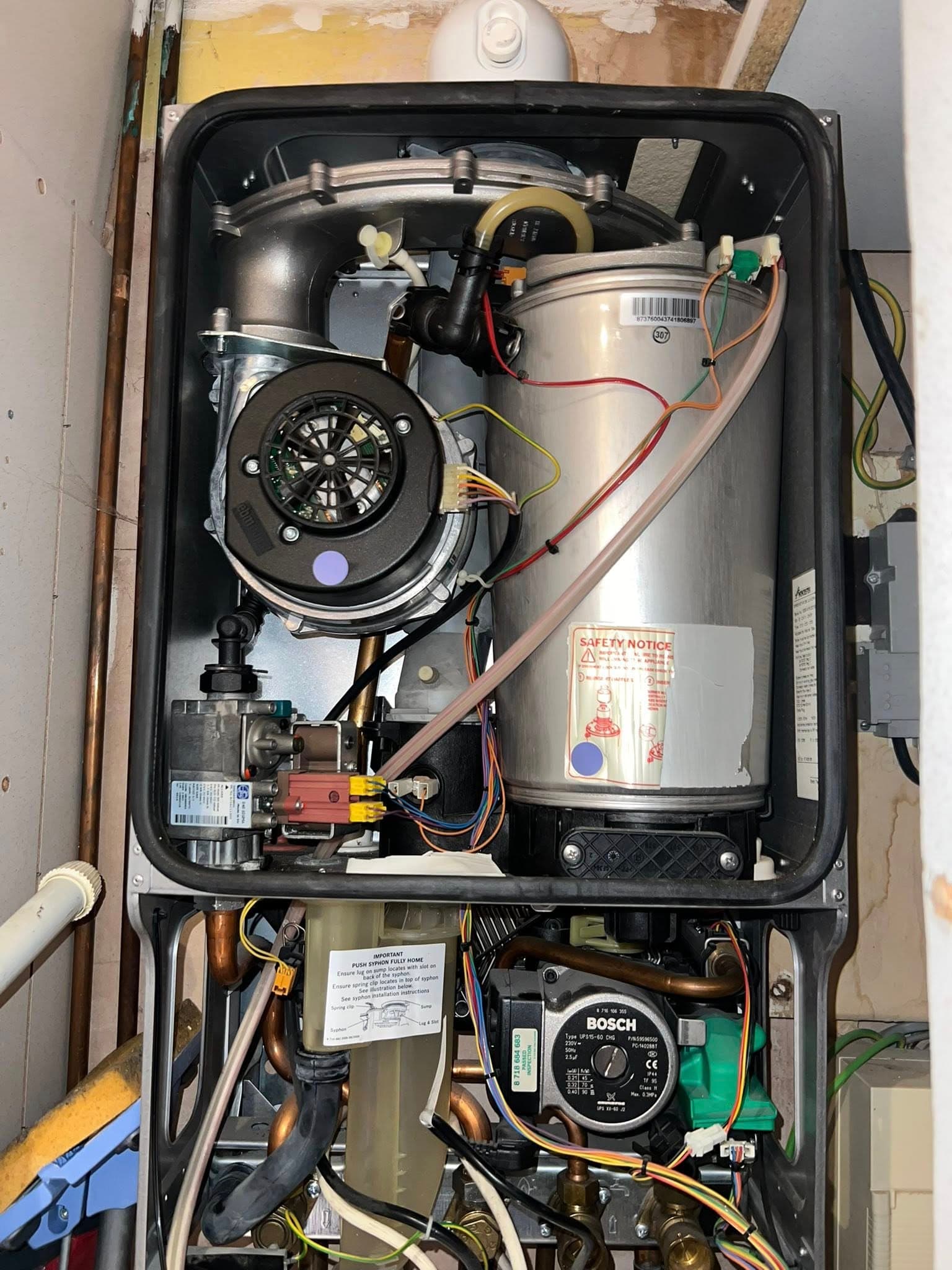
Water appearing under the boiler can come from several internal components, such as seals, the heat exchanger or internal pipework. Common causes include worn seals, corrosion or parts that have started to fail with age.
If the leak is slow and the pressure gauge is dropping, the boiler may be losing water from inside the sealed system. You can safely turn off the power, place a container underneath and turn off the cold water isolation valve to the boiler if you can easily identify it.
Do not remove the boiler cover or panels. At this point a professional diagnosis is needed, as running the boiler with an internal leak can cause further damage and may affect electrical safety.
Dripping from the pressure relief pipe outside
If you see water dripping from a small copper pipe that points towards the ground outside, this is likely the pressure relief valve (PRV) discharging water. It is a safety feature designed to release excess pressure from the system.
Common reasons for water from the PRV include:
High system pressure, often caused by overfilling via the filling loop, can force the PRV to open and then it may not fully reseal. A faulty expansion vessel inside the boiler can also mean pressure spikes when the system heats up, leading to regular discharges.
You can safely check the pressure gauge on the front of the boiler. If it is above around 2.5 to 3 bar when cold, turn the boiler off and avoid using the filling loop. Do not attempt to replace the PRV or recharge the expansion vessel yourself, as this requires specialist knowledge and tools.
Leak near the filling loop
The filling loop is usually a small braided hose with valves, used to top up the boiler pressure. If you notice drips or a damp patch under this area, a valve may not be fully closed, or a joint may have worked loose.
First, ensure both valves on the filling loop are in the closed position, usually at a right angle to the pipe. If they are already closed and you can see water still weeping from a joint or the hose itself, place a towel or tray underneath to catch drips.
If turning the valves gently does not stop the leak, turn off the cold water supply to the boiler or heating system if you know which valve controls it. A plumber or heating engineer can then repair or replace the filling loop and check that the system pressure is correctly set.
Leak from a radiator valve or nearby pipework
Sometimes a leak that appears to be from the boiler is actually from a nearby radiator valve or heating pipe. Water can travel along pipework or drip onto pipes under the boiler, making it tricky to see the true source.
Look carefully at radiator valves, joints, and any visible pipework leading to and from the boiler. A small weep from a compression fitting or valve spindle is often due to a slightly loose connection or worn washer, especially on older systems.
You can gently dry the area with kitchen roll and watch to see where the first damp patch reappears. If the leak is minor, you may be able to keep using the heating temporarily while waiting for a repair, but avoid touching hot or corroded fittings. For anything more than a light weep, it is safer to turn off the heating and arrange a visit from an engineer.
Damp patch under the condensate pipe
Condensing boilers produce condensate, which is usually taken away via a small plastic pipe to a drain. A damp patch under this pipe may be caused by a blockage, a cracked pipe or a loose connection at a joint or trap.
If the condensate pipe is blocked, you might also notice gurgling noises or the boiler locking out with an error code. In winter, external sections of the pipe can freeze, causing water to back up and leak indoors.
You can check that the external pipe has not been physically damaged and that the outlet is not obviously blocked by leaves or debris. Internal access, traps and more complex blockages should be dealt with by an engineer, as incorrect work can lead to further leaks or boiler lockouts.
How hard water can affect boiler leaks
In hard water areas, limescale builds up inside the boiler and pipework over time. This can cause components such as the heat exchanger, valves and seals to work harder and wear out more quickly.
Sludge formed from corrosion and deposits can collect in radiators and low points in the system. This extra strain can lead to higher operating pressures, noisy operation and, eventually, leaks from weakened parts and joints.
Regular boiler servicing and, where suitable, system treatments or power flushing can help keep water quality under control. This reduces the risk of premature component failure and helps your boiler run more efficiently and reliably.
When to call a Gas Safe engineer
If you are at all unsure where the water is coming from, or the leak is anything more than a very minor drip, it is time to speak to a professional. Internal boiler parts, safety valves and gas components must only be worked on by a Gas Safe registered engineer.
For expert diagnosis and safe repair of boiler leaks or urgent plumbing problems, contact Plumbing & Heating Surgeons on 01296200240. If you need help with a leaking boiler, you can also book through our boiler repairs or emergency plumbing pages for prompt, professional support.
Other Articles