Blog
Central heating not working? A quick troubleshooting guide
Follow this simple step‑by‑step guide to narrow down the fault and know when it is time to call a Gas Safe engineer.

When your central heating stops working it is stressful, especially on a busy day or with family at home. This quick guide walks you through simple checks you can safely do yourself, and helps you decide when it is time to call a professional.
Start with basic safety and simple checks
Before you touch anything on your heating system, make sure you know where the boiler isolation switch and main stop tap are. If at any point you see water leaking, smell gas or burning, or feel unsure, stop and call a Gas Safe engineer.
Many heating issues are caused by something simple being turned off or set incorrectly. It is worth checking these first so you do not pay for an unnecessary call-out.
Power supply: Check the boiler and programmer have power and any switches or fused spurs are on.
Room thermostat: Turn it up to at least 22–24°C and wait a few minutes.
Programmer/timer: Make sure heating is set to "On" or "Continuous" while you test.
Boiler display: Look for error codes, flashing lights, or lockout symbols.
If these all look normal, move on to the section that best matches your issue.
No heating but hot water still works
If you have hot water from the taps but no radiators heating up, the boiler is usually working, but the heating side of the system is not being called properly. The fault is often with controls, a zone valve, or circulation.
Check the thermostat and programmer settings
Make sure the room thermostat is on, turned up, and not in an "off" or holiday mode. If it is wireless, check the batteries and that the receiver near the boiler has its lights on and is not showing a loss of signal.
On the programmer or smart control, ensure the heating channel is set to "On" or "Boost". If you have separate buttons for heating and hot water, confirm the heating one is selected.
Look at motorised valves (Y-plan and S-plan)
Many homes use motorised zone valves to send heat either to hot water, heating, or both. On a typical Y-plan system there is a single 3-port valve, often marked H, W and AB. On an S-plan there are two or more 2-port valves, usually one for heating and one for hot water.
When heating is on, the valve serving the radiators should move and you may feel a slight vibration. Some valves have a small manual lever on the side. If it is floppy or stuck, the valve motor may have failed. Do not remove valve heads unless you are competent, as this involves electrical components.
Boiler pressure and circulation
On most sealed systems, the boiler pressure gauge should sit around 1 to 1.5 bar when cold. If it has dropped close to zero, the boiler may not fire for heating. You can usually top it up via the filling loop, following the manufacturer’s instructions.
If pressure keeps dropping, or you are unsure how to top up safely, stop and arrange an engineer visit. Constantly re-pressurising a system without fixing the cause risks further damage.
No heating and no hot water
If you have neither heating nor hot water, the problem is more likely with the boiler itself, the power supply, or the system pressure. Work through these checks methodically.
Check power, reset and error codes
Confirm the main boiler switch is on, any fused spur is switched on, and the consumer unit has not tripped. If a circuit breaker has gone off, reset it once only. If it trips again, call an electrician or engineer.
Most modern boilers have a reset button. If the display shows a lockout or error code, and the manual says it is safe, try a single reset. Repeatedly resetting a boiler that keeps locking out is unsafe and can mask a serious fault, so call a Gas Safe engineer if the issue returns.
Condensate pipe and blockages
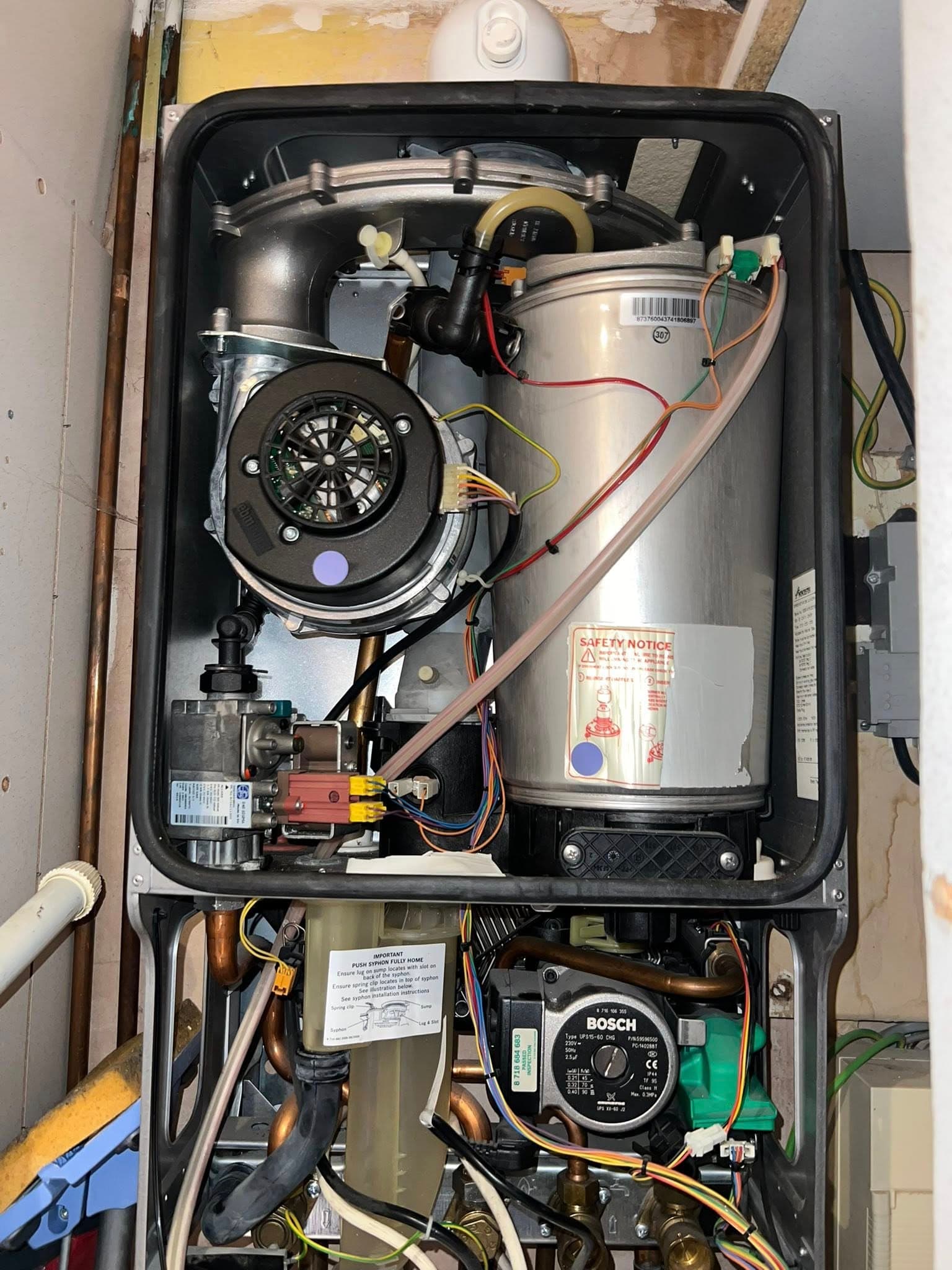
Condensing boilers produce condensation that drains through a plastic condensate pipe. If this pipe blocks or sags, the boiler may shut down with a fault code. Check the visible sections of the pipe for kinks, obvious blockages, or disconnections.
Internal condensate traps can also block over time. Cleaning these usually involves removing covers and should only be done by a qualified engineer, as it means working inside the boiler.
Boiler pressure and leaks
Again, look at the pressure gauge. If it is below the recommended level, the boiler may refuse to run. Only top up if you are confident with the instructions and never leave the filling loop open.
If you see any signs of leaks around radiators, valves, or the boiler, or hear water hissing inside, turn the system off and call an engineer. Leaks can damage the boiler and your home if left unresolved.
Heating works but only some rooms are cold
When some radiators heat properly and others stay lukewarm or cold, it usually points to a local issue. Common causes include stuck valves, trapped air, or sludge build-up restricting flow.
Check radiator valves and balancing
Make sure all radiator valves are turned up, including the lockshield valve at the opposite end from the thermostatic valve. Lockshields are often capped and adjusted with a small spanner or screwdriver.
If a radiator remains stone cold from top to bottom while others are hot, its valve could be stuck shut. Gently turning it back and forth a few times can sometimes free it, but do not force it. Persistent problems should be left to a heating engineer.
Bleed radiators and consider sludge issues
Radiators that are hot at the bottom but cold at the top often have air trapped. Use a radiator key to bleed them carefully, with a cloth underneath, until water appears, then close the vent.
If a radiator is cold at the bottom but warm at the top, that suggests sludge or debris. Chemical cleaning or powerflushing should only be done by professionals with the right equipment to protect your system.
Warning signs to stop and call a Gas Safe engineer
Some issues should never be ignored or tackled by DIY. Stop using the boiler and call a Gas Safe registered engineer urgently if you notice any of the following:
Repeated boiler lockouts or error codes after a reset
Water leaks from pipework, valves, or the boiler casing
Unusual smells, soot, or scorching around the boiler or flue
Loud banging, clunking, or kettling noises from the boiler
Visible flame issues, such as yellow, unstable, or sooting flames
If you ever suspect a gas leak, turn off the gas at the meter if safe to do so, ventilate the area, and follow official gas emergency guidance immediately.
Keeping your heating reliable in future
Regular maintenance greatly reduces the chances of sudden breakdowns. An annual boiler service by a Gas Safe engineer checks safety devices, combustion, seals, and key components before they fail.
System water quality is also crucial. Over time, sludge and corrosion can damage pumps, valves, and the boiler itself. Your engineer may recommend inhibitor chemicals, system filters, or a flush to keep water clean and flowing freely.
Need help getting your heating working again?
If these checks have not solved the problem, or you would rather have an expert take a look, professional help is the safest route. Plumbing & Heating Surgeons can diagnose boiler and central heating faults, repair leaks and valves, and get your home warm again as quickly as possible.
To speak to an engineer or arrange a visit, call 01296200240. You can also book boiler repairs and central heating repairs directly through our service pages and get your system back up and running with minimal fuss.
Other Articles